
DESIGNING THE WORLD OF CHIEF HIJANGUA

Namibian-German colonial history in the form of European opera? This is exactly what happens in september 2023 on the stage of Haus des Rundfunks in Berlin, Germany: in a collective effort, the Momentbühne e.V. portrays the reality of Namibia in the early 20th century and proves that the genre of opera can do far more than just string together complicated coloraturas.
The Namibian journalist Martha Mukaiwa accompanied the process and reports on the development process, special encounters and the creation of 'Chief Hijangua'.
Berlin’s Haus des Rundfunks wasn’t intended for opera but ‘Chief Hijangua’ set designers Tanya Stroh and Felicia Riegel are intent on a little repurposing.
Though the broadcasting centre’s concert hall has no fly system, no curtain, no wings and thus no obvious way of changing scenes, Stroh and Riegel have devised a plan to fashion the Namibian landscapes of Hijangua’s four-act desert odyssey amid the imposing wood paneled and terraced structure in the German capital.
To begin, it was important to journey to the past. To a year ago when the Namibian-German opera ‘Chief Hijangua’ first opened in the relatively traditional black box that is the National Theatre of Namibia in Windhoek.
In ‘Chief Hijangua’ which is performed in Herero and German, a Namibian royal sees the woman he loves choose another. Lovesick and disillusioned, Hijangua leaves his community and his vibrant homeland to embark on a journey through the desert. On the brink of succumbing to the harsh conditions, Hijangua is eventually rescued by a German pastor and his daughter. The young prince is initially welcomed into their military settlement before returning home a changed man.
“We re-watched the entire opera through the lens of needing to do it from scratch,” says Stroh who joined a February 2023 production team trip to Berlin to reimagine ‘Chief Hijangua’ for the Haus des Rundfunks stage.
“We then had a week long brainstorming and workshopping session which gave us an opportunity to look at the production with fresh eyes and actually work with some of the themes,” says Stroh.
“It was very collaborative and consultative in that we had Nikolaus Frei, the writer, and Eslon Hindundu, thecomposer, there so we could unpack a lot of things and work with them directly,” Stroh says.
“For example, land and soil were themes and images that constantly came up. We had to ask: What is it about them that appeals to us so much? I think getting clarity on that ultimately gave us a basis to then build a prototype.”
As Haus des Rundfunks is a working centre and the Namibian and German crew would be returning to their respective homes after the workshopping session, Riegel built a two-scale model of Haus des Rundfunks’ concert hall to plot the stage design.
“We would take Styrofoam shapes, tear pieces of paper and, starting with hierarchies in a Herero family, plot how we could position characters. We got quite physical with trying to imagine the space and from there, the concept evolved,” says Stroh.
With Stroh in Namibia and Riegel in Germany, much of Chief Hijangua’s set was conceptualized and designed via Zoom call in a mix of independent and joint research and sharing of conceptual thinking.
“Land is a big part of our creative concept. The challenge with this space is that we don’t have the opportunity to change the landscape because of the way space is set up. There are no wings, no fly bars, you can’t change scenes,” says Stroh.
“So what we conceptualized is a single landscape that isn’t inspired by a site specific place but rather the feeling of the contrast of the country,” she says.
“In Namibia, sometimes you’re confronted with very flat, horizontal spaces but also mountainous landforms that you feel small and insignificant next to. So it’s more about the vibe of it that we’re trying to create,” she says.
“The space is also a universal space in the sense that it’s a space and time through which Hijangua is travelling through his life but he’s also travelling through these physical spaces.”
Another important element of the stage design is the use of sand. Namibia is known for its vast deserts, savannah and the material wealth beneath the sand.
“We used molded Styrofoam and draping to look like a landscape and towards the front of the stage we are using real sand. Believe it or not, in Germany, there’s a whole company that specializes in sand. They ask things like: Would you like it filtered or would you like it beach?” says Stroh incredulously.
“‘Sand is what all the different places the opera takes place in have in common. The Waterberg, the travel through the Namib desert and the coastline have sand in common. So we tried to reduce the set design to the one common material/surrounding,” says Riegel.
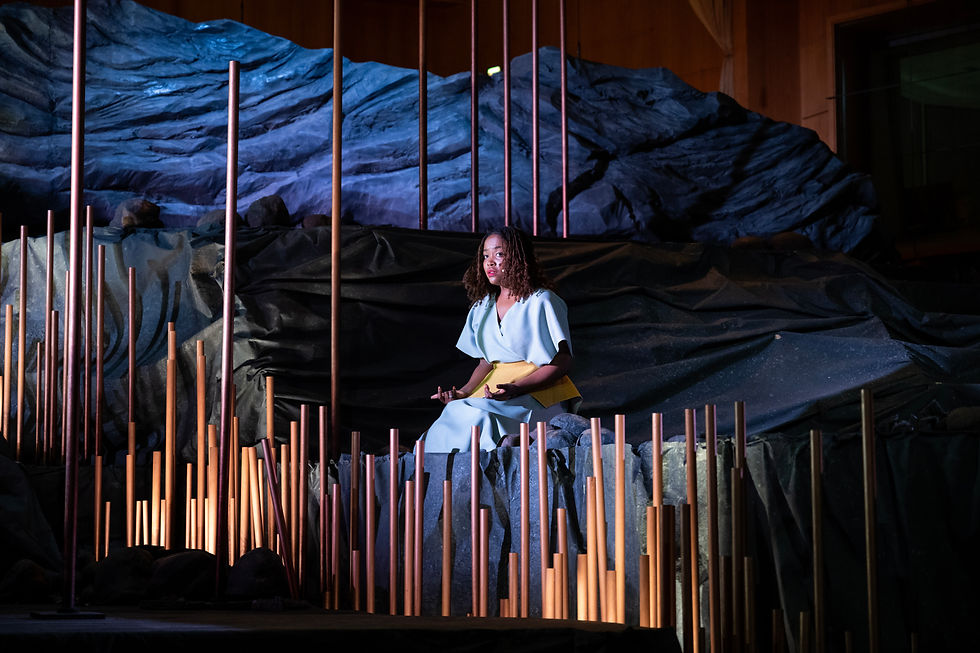
“It was important to us to bring some Namibian elements and materials to this installative stage to give the audience a materialistic impression of the desert country where the story takes place,” says Riegel. “I remember so vividly this dusty dry feeling and special air and light from my short time in Windhoek last year.”
Riegel adds that sand is also a material symbol of land ownership which is one of ‘Chief Hijangua’s’ underlying themes.
“When you’re colonizing, it’s a very intentional act of claiming land that is not yours. Beyond that, thematically, land has also claimed the bodies of thousands and millions of people. Bodies are the land and they’ve traversed that space like Hijangua has traversed that space. Land is so layered for its symbolism,” says Stroh. “Land and its ownership still remains a contentious issue in Namibia and we wanted to make it physical for the audience.”
Land and sand additionally underpin ‘They tried to bury us’, Namibian artist Isabel Katjavivi’s live quote and installation on stage and in Haus des Rundfunks’ foyer.
Katjavivi’s mask and sand installation is concerned with the Herero and Nama Genocide of 1904 – 1908 in which tens of thousands of Herero and Nama people were killed by German colonial forces by order of Lieutenant General Lothar von Trotha.
“The installation in the foyer will be a point of reference for the audience as they make their way inside. There will be a dramatic change to the installation in between acts to portray the horror of the time,” says Katjavivi. “Apart from the installation, we have kept the original idea of last year where the cast and choir hold masks on stage.”
‘They tried to bury us’ first showed at the National Art Gallery of Namibia in 2018. Since then, it has been displayed in various forms in Cameroon, South Africa and Germany.
“The participants on stage, team members and supporters gave us their faces to mould and create the masks on stage. Behind every masks lies a different story, a different character and a different connection to the opera,” says Katjavivi.
“To see the life of ‘They tried to bury us’ evolve has been amazing. This work has grown in many ways. I have seen it be viewed by people from many places and one thing that’s seems to be apparent, is that a scene like that is something that every nation, land, people have sadly experienced in some way, shape or form,” says Katjavivi.
“It is a shared mourning. When this is felt and seen, people have been able to lend themselves to the pain Namibia experienced, and lend their empathy.”
Along with land and sand, copper is a suggestive feature of ‘Chief Hijangua’s’ set design.
“Felicia had this idea to work with copper pipes. So we have this built landscape but there is a strong use of copper as a way to symbolize borders and natural resources,” says Stroh.
“We are trying to work with tension in the space but also using copper as a storytelling technique to ask: Why would Germans come here in the first place? What is here? What would drive someone, even Hijangua, to make a certain political choice? Is it over land ownership, is it over the resources attached to the land?” says Stroh.
“So it’s not just Hijangua’s personal story but maybe the realm in which the story operates. The use of copper was a way for us to weave in that realm in a way that’s symbolic but also gives us something to work with. Materiality was very important for us in the stage design; working with sand, rock or metal. Materiality is also included in the accessories of everybody’s costumes.”
For both Stroh and Riegel, the challenge of ‘Chief Hijangua’s’ stage design at Haus des Rundfunks was a matter of transforming such an iconic, largely monochromatic and purposeful space.
“What was always really challenging but, in a good way, was: How do we transport the audience to feel like they are not in Haus des Rundfunks? How do we create a space through which the soloists and everybody can perform but the audience feels as if they are somewhere else?” says Stroh.
“What I appreciated about this version of the opera was working with a film industry art department workshop. We submitted all the technical drawings and they then realise the building of the set. We’re also working with an inclusive workshop and they provide work for people living with disabilities and they did a lot of the rock formations for us,” says Stroh.
“The rock formations are all made of papier-mache but it looks like the real thing. Lights are a whole extra aspect and lighting forms a critical part of staging. Of course theatre is about magic and imagination.”
Comparing the Haus des Rundfunks set design to the staging showcased at the Namibian national theatre, there is one thing that has made all the difference.
“Budget,” says Stroh.
“The stage design is way more elevated in terms of its execution because the increased budget made way for creative possibility.”
As much as the music of the Namibian-German opera is the star of the show, so is the stage design, particularly for those who have visited Haus des Rundfunks’ concert hall before.
“Musically, of course, the acoustics are fantastic. But I think - in terms of what we’re putting in there - no one has ever seen Haus des Rundfunks that way before. So that’s pretty exciting,” says Stroh.
“I hope we create some sense of awe. That people will think: They did what?!” Stroh says.
“I hope people are blown away a little bit. That they are transported, that they are not in Haus des Rundfunks in Berlin anymore but in some other world.”
Text by: Martha Mukaiwa, 2023.


Kommentare